After spending years moving between accounting, finance, and product roles inside organizations, I noticed a pattern that quietly kills revenue long before anyone ever sees it.
It was not poor sales execution or lack of market opportunity. It was not discounting mistakes, although I have seen refunds in place of discounts calculated on spreadsheets, which is not best practice, especially when the refund is issued across quarter ends. It was not product itself since most teams build with a creative monetization strategy in mind.
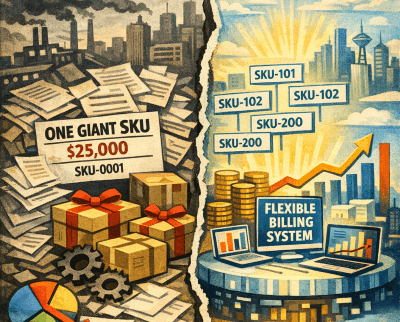
The real problem is the billing system companies ignore early on. The typical billing systems young companies start with cannot support anything beyond basic pricing models. As a result, teams talk a lot about “monetization strategy,” “value-based pricing,” and “creative packaging,” but cannot act on any of it because their systems do not support complex contracts, flexible billing or proper revenue recognition.
Build Your Monetization Around SKUs
If you’re not an accountant, a SKU (pronounced “skew”) is simply a unique code a company gives to each product or service it sells. Think of it like a name tag that tells everyone exactly what something is, including its features, size, version, or plan. SKUs matter because they keep the business organized. They help teams understand what is being sold, how it should be priced, how it fits into bundles, and how it shows up in billing and reporting.
When companies build their pricing, billing, and reporting around clean, well-defined SKUs, everything runs smoother. They avoid messy one-off exceptions and speed up processes from sales cycles to revenue recognition. It also becomes easier to launch new offers, test bundles, and scale globally because everyone from Sales to Finance to Engineering is using the same name for the thing they are selling.
If you want a more flexible monetization strategy that supports different pricing models, varied customer segments, and mixed contract terms, strong SKU discipline is one of the simplest and smartest ways to stay agile and grow.
Why Billing by SKU Matters
If your billing system cannot bill by SKU, you cannot modularize your product, track true usage, or design pricing that reflects how customers actually use your product.
Here’s why this makes such a difference.
1. SKUs Are the Building Blocks of Monetization
A SKU can represent a product, feature, add-on, usage metric, integration, support tier, data pack and more.
If your billing system cannot track usage, entitlements, and revenue at the SKU level, you are stuck with one-size-fits-all pricing — one plan, one price, no flexibility.
2. SKU-Level Billing Enables Modular Packaging
When your product is made up of SKUs, you can easily design plans that fit different customer needs. For example:
This gives you unlimited flexibility to:
SKU modularity lets Sales be creative without breaking Finance or Operations.
3. SKU-Level Tracking Helps You Understand Your Customers
Utility companies like Pacific Gas & Electric (PG&E) charge different prices at different times of day. Electricity costs more during “peak hours” because demand is high and it’s more expensive for PG&E to produce power. During “off-peak hours,” prices drop because demand is lower and PG&E can rely more on cheaper renewable energy like solar to produce power. By offering lower prices during off-peak hours, PG&E encourages customers to shift their usage times when power is cheaper to supply and to level out demand. In simple terms, “peak hours” and “off-peak hours” are treated as different SKUs. This helps PG&E manage their costs and demand while giving customers a way to save money, which is a win for everyone.
The same idea applies to any business. When every product, feature or service is defined as its own SKU, you get a clear picture of what each customer actually uses and values. With SKU‑level tracking, you can tailor packages for different customer segments, find cross‑sell and upsell opportunities, run targeted pricing tests, increase revenue without raising churn, and forecast revenue with much greater accuracy. It is the same reason PG&E asks new customers in California whether they own an electric car. If they do, PG&E can offer a special night-charging plan that reduces pressure on the grid during peak hours, lowers the chance of brownouts, and optimizes profitability.
None of that is possible when your entire product is lumped into one giant SKU. SKU-level detail gives you the visibility you need to guide customer behavior, just like PG&E does. Customers benefit too, for example by paying less to charge their car at night. Ironically, it is all the same physical product (electricity) but with smart SKU tracking makes it far more flexible and efficient.
4. SKUs Make Revenue Recognition Accurate, and Automated
When each SKU has its own revenue rule: delivered over time, delivered at a point in time, usage-based, hybrid, and variable consideration, the entire revenue recognition becomes:
This reduces risk, prevents compliance issues, and removes manual month-end work.
The Key Takeway
Billing by SKU is not back-office accounting mumbo-jumbo. It is the foundation of a clear and actionable monetization strategy. When companies can bill at the SKU level, they gain flexibility to create better bundles, price for different customer segments, monetize usage and add-ons, and recognize revenue accurately. BillAgent can help teams do this at scale. In the end, SKU-level billing isn’t just an operational feature. It’s a growth engine that many companies don’t realize they’re missing.
Note: This post is for insights and discussion only, not professional advice. Every business is different, so check with your CPA or financial advisor before making decisions.